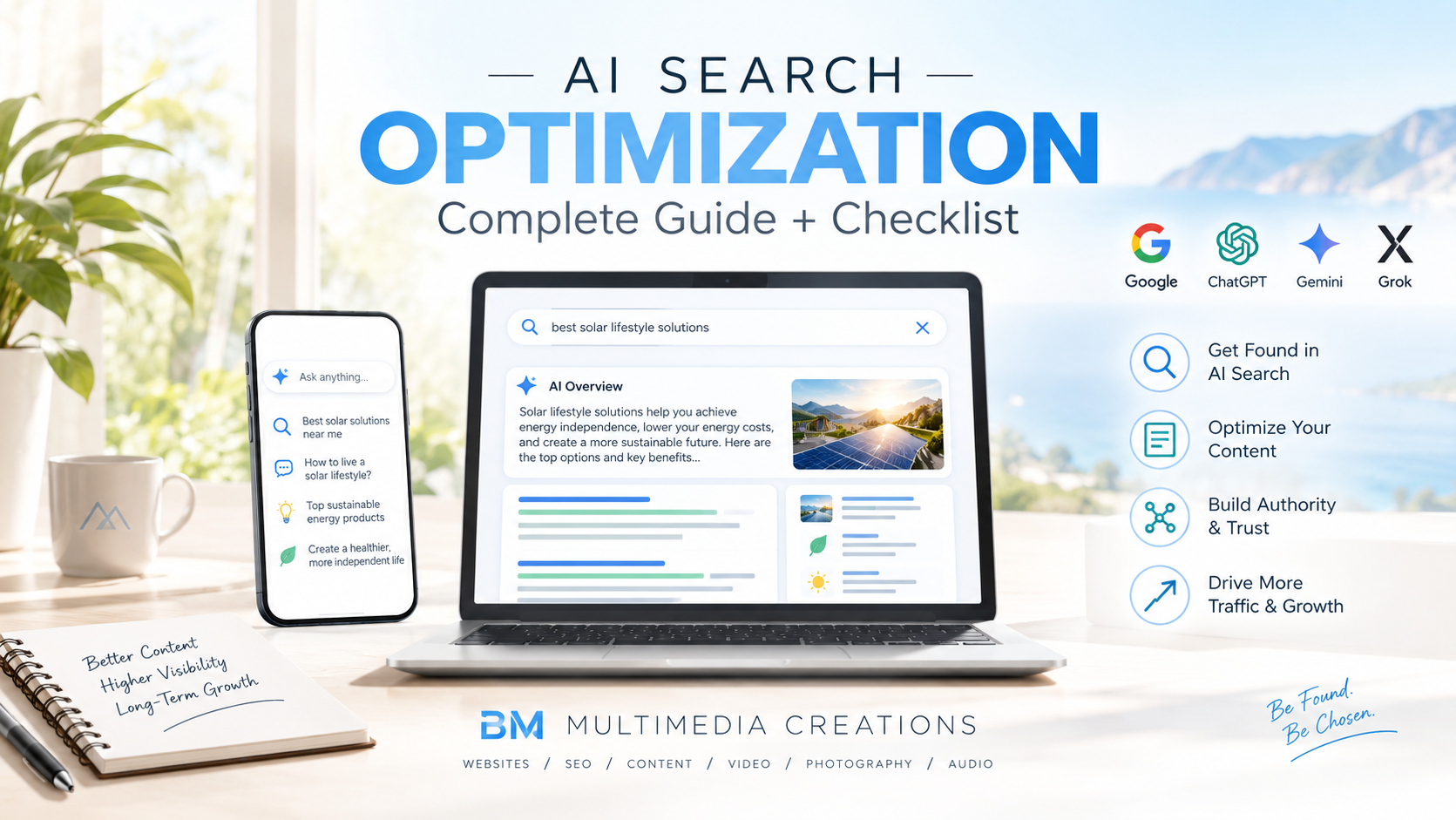
People no longer just Google. They ask ChatGPT, Gemini, Perplexity and Google’s AI Overviews who to hire, which product to buy and where to go, and they often get one short answer instead of a list of links. If your business is not in that answer, your competitor probably is.
This guide explains what AI search optimization is, how it differs from traditional SEO, and the practical steps you can take today. At the end you will find a one-page cheat sheet you can follow step by step, and download for free.
What is AI search optimization?
AI search optimization is the practice of making your business easy for AI tools to find, understand, trust and recommend. You will also see it called Generative Engine Optimization (GEO) or Answer Engine Optimization (AEO). The names differ, but the goal is the same: to be named or cited inside the AI’s answer, not just listed on a results page.
How is it different from traditional SEO?
The two overlap more than most people think. Good content, a fast and crawlable website, strong reviews and real authority help in both. The differences are in emphasis:
- Traditional SEO aims to rank your pages in a list of search results.
- AI search optimization aims to get your business described, recommended or cited in a generated answer.
- AI tools lean heavily on clear structure, direct answers, structured data and what the wider web says about you, so those matter more than ever.
If you already invest in SEO, you have a head start. AI optimization builds on it. It does not replace it.
9 steps to get recommended by AI
1. Check what AI says about you today
Before changing anything, ask. Open ChatGPT, Gemini, Perplexity and Google, and type the questions your customers would ask, such as “best web design agency for small businesses” or “who can help me with eCommerce SEO”. Note whether you are mentioned, whether the description is accurate and who appears instead. This is your baseline. Because AI answers vary from one try to the next, repeat each question a few times and look for patterns rather than single results.
2. Make sure AI crawlers can reach your site
If your site blocks the crawlers AI tools use, you can be left out of their answers. Review your robots.txt file and your security or firewall settings. Check that you are not accidentally blocking bots such as GPTBot, OAI-SearchBot, PerplexityBot and Google’s crawlers. Whether to allow each one is your decision, but make it on purpose, not by accident. Your pages should also be indexed in Google and Bing, since many AI tools draw on those indexes.
3. Answer real customer questions, directly
AI tools like content that answers a question clearly. Write pages around the questions customers actually ask, and put the answer first.
- Use the question as a heading.
- Give a direct answer in the first one or two sentences.
- Then add detail, examples and context.
- Add an FAQ section to your key pages.
This “answer first” style helps both AI tools and human readers who are in a hurry.
4. Structure your pages so they are easy to read
Clear structure helps machines understand your content. Use one H1 per page, descriptive H2 and H3 headings, short paragraphs, bullet points and simple tables where they help. Avoid hiding important information inside images, videos without text, or tabs that do not load for crawlers.
5. Add structured data (schema markup)
Schema markup is code that tells search engines and AI tools exactly what your content is. Useful types for most businesses include Organization or LocalBusiness, Service, Product, FAQPage, Review and Article. Schema does not guarantee a mention, but it removes guesswork and helps your information be understood correctly. Test your markup with Google’s Rich Results Test.
6. Be consistent about who you are
AI tools build a picture of your business from many places. Make sure your business name, description, services, address, phone number and links are consistent on your website, Google Business Profile, social profiles and directories. Conflicting details create confusion, and confusion means you are less likely to be recommended.
7. Build authority and earn mentions
AI tends to recommend businesses the web already trusts. That means:
- Collecting genuine customer reviews.
- Being listed in reputable industry directories.
- Earning mentions in articles, podcasts, interviews and partner sites.
- Publishing expert content that others want to cite.
There is no shortcut here. Authority is built over time through real work that people talk about.
8. Show real expertise and experience
Publish content that proves you know your field: case studies, original examples, clear author names and credentials, and honest explanations. Content that reads like a generic summary of everything else online is less likely to be cited than content with a real point of view. Our case studies show one way to present results.
9. Keep your site fast, secure and mobile-friendly
Technical basics still matter. Pages should load quickly, work well on phones, use HTTPS and be easy to crawl. A slow or broken site is a weak foundation for both search rankings and AI visibility.
What about llms.txt?
You may have heard about llms.txt, a proposed file that gives AI tools a simple summary of your site. It is cheap to add and harmless, but no major AI platform has confirmed that it uses the file to decide what to recommend. Treat it as a small optional extra, not a replacement for the steps above.
Can anyone guarantee AI will mention my business?
No, and be cautious of anyone who says they can. AI platforms do not publish exactly how they choose sources, and their answers change. What you can do is improve the factors within your control (content, structure, authority, reviews and technical health) and measure your visibility over time.
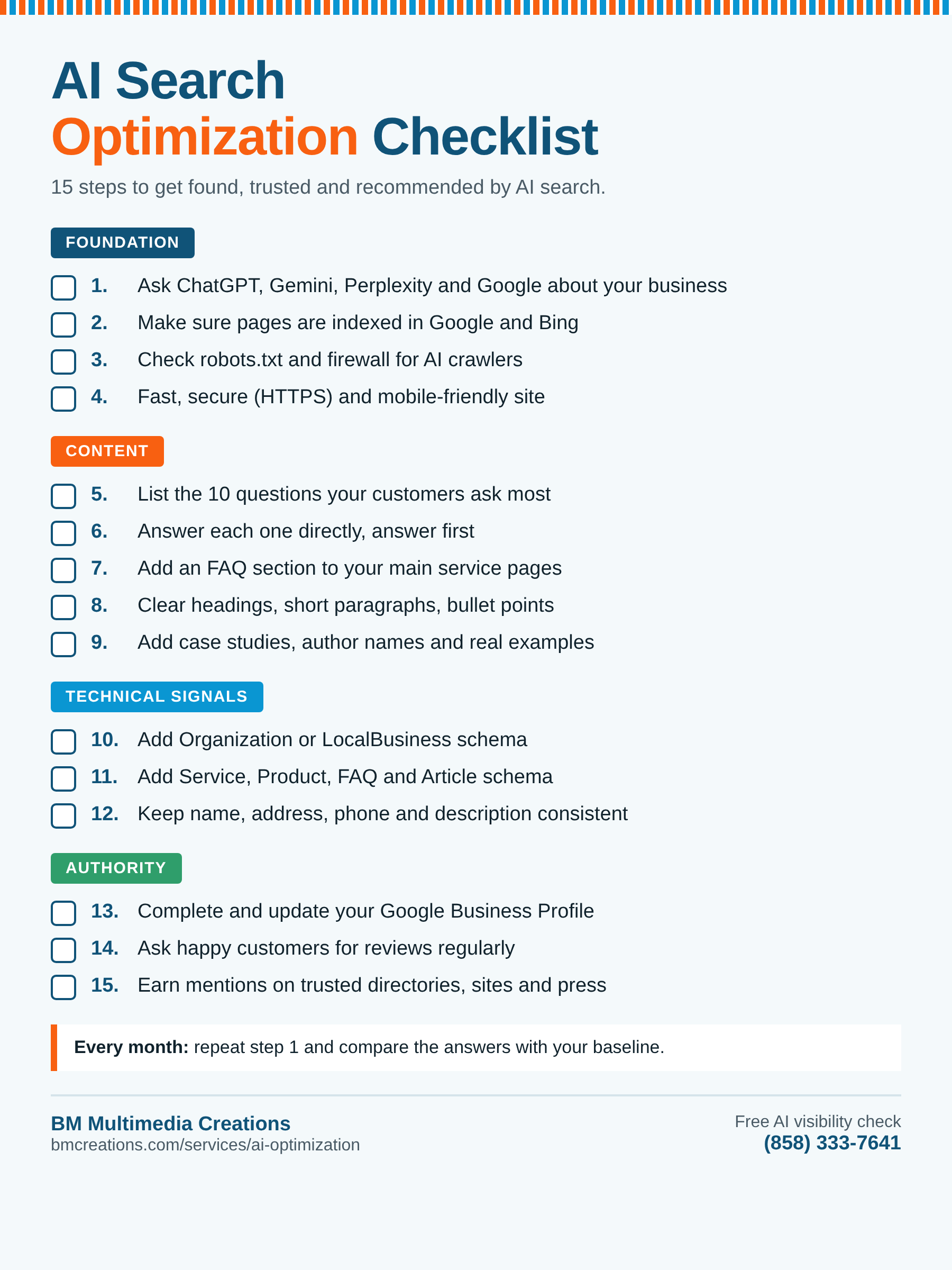
The checklist in text
Foundation
- Ask ChatGPT, Gemini, Perplexity and Google about your business and note the results
- Make sure your pages are indexed in Google and Bing
- Check robots.txt and firewall settings for AI crawlers
- Make the site fast, secure (HTTPS) and mobile-friendly
Content
- List the 10 questions your customers ask most
- Answer each one on its own page or section, answer first
- Add an FAQ section to your main service pages
- Use clear headings, short paragraphs and bullet points
- Add case studies, author names and real examples
Technical signals
- Add Organization or LocalBusiness schema
- Add Service, Product, FAQ and Article schema where they apply
- Keep business name, address, phone and description consistent everywhere
Authority
- Complete and update your Google Business Profile
- Ask happy customers for reviews on a regular basis
- Earn mentions on trusted directories, partner sites and in the press
Re-check every month: repeat the questions in step 1 and compare the answers with your baseline.
Frequently Asked Questions
Want Help Being the Business AI Recommends?
At BM Multimedia Creations we run an AI visibility check, fix the technical foundations, build answer-ready content and track your progress month by month. Learn more about our AI optimization services or explore our digital marketing services.