Podcasts are one of the best ways to build trust, but they have one big weakness: search engines and AI tools cannot easily listen to audio. They read text. If your episodes live only in a podcast app, much of the value stays hidden.
The good news is that a few simple habits can turn every episode into content that Google, YouTube, podcast apps and AI tools like ChatGPT, Gemini and Perplexity can find, understand and recommend. This guide shows you how, and ends with a checklist you can follow for every episode.
Why podcast SEO and GEO matter
People discover podcasts in three main ways: inside podcast apps, through Google and YouTube, and increasingly by asking AI assistants questions such as “what are the best podcasts about [topic]?” or “who can explain [topic]?”.
- SEO (search engine optimization) helps your show and episodes appear in search results.
- GEO (Generative Engine Optimization), also called AI search optimization, helps AI tools find, trust and mention your show, your guests and your expertise in their answers.
The two overlap heavily, and both start with the same thing: clear, well-structured text that describes what your show is about. If you want the background, read our guide to AI search optimization.
1. Give your show a clear name and description
Your show title and description are the first things apps, search engines and AI tools read.
- Make the show title memorable first, and descriptive second. If your name does not explain the topic, add a short subtitle, such as “The Growth Hour: Marketing Tips for Small Businesses”.
- Write a show description that says plainly who the show is for, what topics it covers and what listeners will learn. Use the words your audience would actually search.
- Choose the most accurate category and keep your artwork, host name and description consistent everywhere.
Avoid stuffing keywords into the title. It reads badly and can work against you.
2. Write episode titles people would search for
Each episode title is a chance to match a real question.
- Put the topic first, then the guest or hook: “How to Write a Press Release That Gets Read (with Jane Smith)”.
- Use plain language that matches how people search, not clever puns that only make sense after listening.
- Keep it short enough that it is not cut off in apps and search results.
- Include the episode number only if your audience uses it. It does not help search.
3. Create a page for every episode on your own website
This is the single most important step. Podcast apps are rented space. Your website is the place you own, and it is where search engines and AI tools can read the full story.
Give every episode its own page with its own URL, and include:
- The episode title as the main heading (H1).
- An audio player (and the video, if you record one).
- A short summary in the first paragraph, answering “what is this episode about and who is it for?”.
- Key takeaways in bullet points.
- Guest name, short bio and links to their website and profiles.
- Links to resources, tools and books mentioned.
- Links to related episodes and relevant pages on your site.
- A clear call to action.
Do not put all your episodes on one long page. One page per episode gives each one a chance to rank.
4. Publish a full transcript
A transcript turns audio into the text that search engines and AI tools can read. It is also the best way to make your show accessible to people who are deaf or hard of hearing, and to people who prefer reading.
- Add the transcript to the episode page as real, crawlable text. Do not hide it in an image, a locked PDF or a pop-up.
- Clean it up. Fix names, brand terms and obvious errors, and add speaker labels.
- Add headings or timestamps for the main topics so readers can skim.
Major podcast apps now support transcripts too, so upload yours through your hosting platform where possible.
5. Add chapters and timestamps
Chapters help listeners jump to what they need, and they give search engines and AI tools a clear outline of the episode. List them on your episode page, and add them to your podcast file or video platform if supported.
Write chapter titles as short descriptions or questions, for example “Why most podcasts do not show up in Google”.
6. Write answer-first show notes (for GEO)
AI tools like content that answers questions directly. Structure your show notes like this:
- A one or two sentence summary that answers the main question of the episode.
- A list of the questions the episode answers, each with a short answer.
- Key takeaways.
- Names of the people, companies and topics discussed.
This helps both people and AI tools lift out accurate answers and attribute them to you.
7. Add structured data (schema markup)
Schema markup is code that tells search engines exactly what your content is. For podcasts, the useful types are PodcastSeries for your show, PodcastEpisode for each episode, and Person for hosts and guests. You can also add FAQPage markup if you include an FAQ section, and VideoObject if you publish the episode as a video.
Schema does not guarantee better rankings or AI mentions, but it removes guesswork and helps your information be understood correctly. Test it with Google’s Rich Results Test. Many SEO plugins can add it for you.
8. Publish on YouTube as well
YouTube is one of the most popular places to listen to podcasts, and it is also a major search engine. If you record video, publish the full episode with a clear title, description, chapters and transcript or captions. Even an audio episode with a still image can work. Link back to your episode page in the description.
9. Submit to all the main directories
Use a podcast hosting service to publish one feed (RSS) and submit it to Apple Podcasts, Spotify, YouTube Music, Amazon Music and others. The more places your show appears, the more chances people have to find it. Use the same name, artwork and description everywhere so apps and AI tools recognize it as one show.
10. Build authority through guests, links and reviews
Search engines and AI tools tend to trust shows that the rest of the web talks about.
- Invite guests and ask them to share their episode and link to it from their website.
- Appear on other podcasts and make sure your bio links back to you.
- Ask for reviews on the platforms your audience uses.
- Get mentioned in articles, directories and newsletters. A well-timed press release can help announce a launch or milestone.
There is no shortcut. Authority is built over time through content that people value and share.
11. Repurpose every episode
One episode can become many pieces of content: a blog post, short video clips, quote graphics, newsletter issues and social posts. Each one gives you another chance to be found, and each one should link back to the episode page.
12. Keep your website healthy
Technical basics still matter. Make sure your pages load quickly, work well on phones, use HTTPS and can be crawled. Check that your robots.txt file and security settings do not block the search and AI crawlers you want to reach you. Our SEO services cover these fundamentals.
How to measure results
- Google Search Console: see which searches bring people to your episode pages.
- Your podcast host’s analytics: track downloads, listeners and where they come from.
- YouTube analytics: see views, watch time and search terms.
- AI checks: every month, ask ChatGPT, Gemini, Perplexity and Google questions your audience would ask, and note whether your show or guests are mentioned. AI answers vary, so look at trends, not single results.
Can anyone guarantee my podcast will appear in AI answers?
No. AI platforms do not publish exactly how they choose sources, and their answers change. What you can do is improve the things within your control: clear text, structure, authority and technical health, then measure over time.
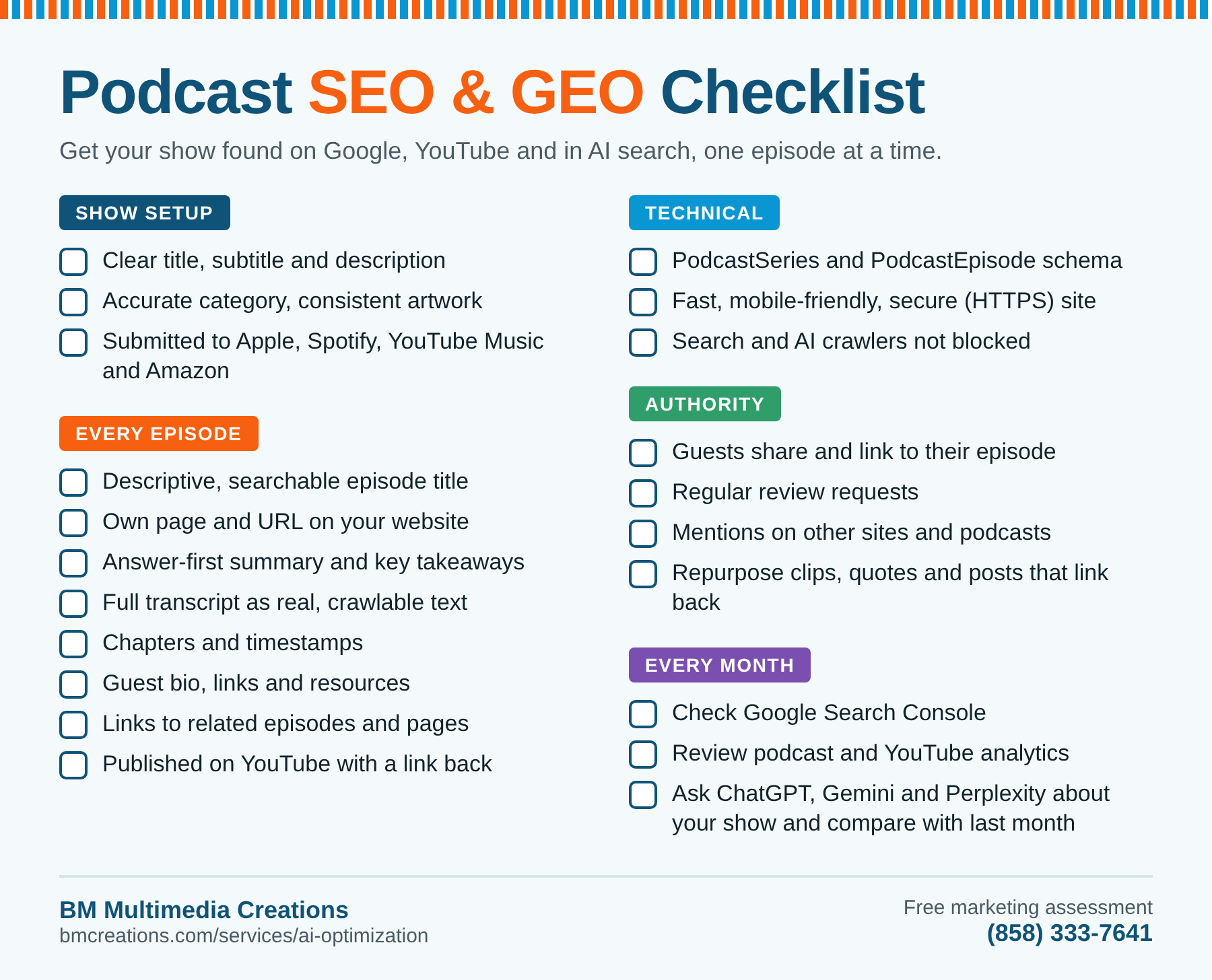
Podcast SEO and GEO checklist
Show setup
- Clear show title, subtitle and description
- Accurate category and consistent artwork
- Submitted to Apple, Spotify, YouTube Music and Amazon
Every episode
- Descriptive, searchable episode title
- Own page and URL on your website
- Answer-first summary and key takeaways
- Full, cleaned-up transcript as text
- Chapters and timestamps
- Guest bio and links, resources mentioned
- Links to related episodes and pages
- Published on YouTube with a link back
Technical
- PodcastSeries and PodcastEpisode schema
- Fast, mobile-friendly, crawlable site
- Search and AI crawlers not blocked
Authority
- Guests share and link to their episode
- Regular review requests
- Mentions on other sites and podcasts
Monthly
- Check Search Console, podcast analytics and AI answers
Frequently Asked Questions
Need Help Getting Your Podcast Found?
At BM Multimedia Creations we help businesses and creators get found on Google and in AI search, from episode pages and schema to content and authority. Learn more about our AI optimization services and SEO services.